



Call Silver Star at 828-321-4268

220 Cabriolet A & B 1951-1955
HISTORY of the 220 Cabriolet A & B
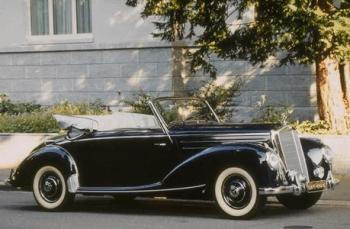
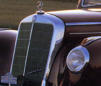
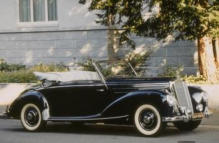
The 220 series was the first new body style produced after the war. The classic body style from the
170 remained with few changes. The headlights were placed in the fenders rather than on top of them.
The Cabriolet came in two styles, the A; which was a two passenger vehicle with a rear jump seat, and
the B; which was a roomy four seater with rear quarter windows. Coupes were also made during the
"second series" 1954-1955, and are extremely rare. Eighty-five coupes were produced, thirteen of them
with sunroofs. The 220 model was the last to have suicide doors.
The first series Cabriolet A's were trimmed differently than other 220's. The dash leather was
trimmed out in the same color as the seats, the dash top had veneered wood in burled elm, burled walnut
or burled rosewood also matching the seat color, wool carpeting which was bound in scived leather also
matching the seats, the trunk was carpeted in tan wool to match the optional fitted luggage. The
Cabriolet A is the most collectible and valuable 220 model today.
The Cabriolet B had an all-metal subframe. Interior trim cloned that of the sedan's; solid ash
dashboard top, wood and metal were dark brown regardless of trim color, and the wood was not stained,
but varnished for a near-opaque finish.
In 1954 the 220 Cabriolet A completely replaced the Cabriolet B and sedan. These are considered
the "second series" cars, but were virtually unchanged. The only change was the curved windshield which
distiguishes them from the "first series" automobiles. Also produced during the "second series" was the
coupe. The coupe is extremely rare and highly prized as only 85 were built.
These cars are magnificant sculptures with elegant lines and fine interiors, and they are sound buys when
they need little or no restoration. However, if you are going to keep the car and enjoy it, a restoration is
worth every penny.
Production Numbers:
Production Numbers of the 220 Cabriolets A & B from July 1951 to August 1955
The chassis prefix for Cabriolet A is 187 013
The chassis prefix for Cabriolet B is 187 012
220 Cabriolet A 1951-1955
997 units
220 Cabriolet B 1951-1955
978 units
220 Coupe 1954-1955
85 units
220 Cabriolet A 1954-1955
300 units
Total:
2360 units
Buying A 220 Cabriolet A & B
Know what you're buying and what to look for and know what to avoid.
When these cars are well maintained and properly taken care of, they increase in value.
PLEASE READ THIS FIRST!
A car's value is determined by condition. Standard condition guidelines are as follows:
Excellent- As close to perfect original or a very well restored vehicle. Generally a body-off restoration, but
a well done body-on restoration that has been fully detailed may qualify. The vehicle is stunning to look at.
Everything works as new, all equipment is original, NOS or excellent quality reproductions. PLEASE KEEP IN
MIND THAT # 1 CARS ARE VERY RARE, AND ARE ORIGINAL RIGHT DOWN TO THE HOSE CLAMPS. DO NOT
ASSUME THAT JUST BECAUSE A CAR HAS A #1 ASKING PRICE, THAT IT IS IN # 1 CONDITION. MOST
CARS FOR SALE OUT THERE ARE LOW # 2 TO HIGH # 3 CARS.
Very Good- An extremely presentable vehicle showing minimal wear, or a well restored vehicle. Runs and
drives smooth and tight. Needs no mechanical or cosmetic work. All areas have been detailed. Beautiful to
look at but clearly not a # 1 vehicle.
Good- Presentable inside and out with some signs of wear. Not detailed but clean. Body should be straight
and solid with no rust-through anywhere. Shiny, attractive paint but may have evidence of minor fading or
checking or other imperfections. Runs and drives well but may need some minor mechanical or cosmetic
work. But it is useable and enjoyable as is.
Fair- Runs and drives ok but needs work throughout the vehicle. Body shows signs of wear or previous
restoration work. Any rust should be minimal and not in any structural areas. Cosmetics, body and
mechanicals all need work to some degree.
Poor- In need of complete restoration, but is complete and not a rust bucket beyond repair. May or may not
run but is not roadworthy.
These values are from Collector Car Market Review and are based on actual sales of vehicles,
not on asking prices of vehicles. Asking prices, and sales prices are very different.
Currently: (these are approximate values based on actual sales of vehicles.) Prices last updated Sept 2019
Keep in mind that due to the high cost of restoration, mint examples of these cars can and
have sold for more than the prices quoted here.
Where to find the engine number and chassis number. -- The chassis number is located on the right front
frame rail. and the engine number is located on the left side of the engine block below the cylinder head.
The vehicle data tag is located on the firewall on the right side. Look at the car in general. Walk around the
car several times looking at the gaps for the doors, trunk and hood. Look at the general overall condition
of the car.
Condition of a car CANNOT be determined by its location. Don't be fooled by a car's current geographical
location. Just because a car is in California today, does not mean that is where it started life. The Cab A
and the coupe have wooden body frames; because of this it will deteriorate over time, especially if
moisture gets to it. The best way to check for this is to look closely at the suicide doors. If they sag,
remove the driver's doorsill trim to expose the wood. Replacing the wood is rather expensive, and it can
only be done with the car taken completely apart. The frame box section that bolts the body to the frame
needs to be checked for rust. The aluminum mounting pads between the frame and box section and the
floorboards need to be checked as well. At present, mechanical parts for this car have been no problem in
getting. Sheetmetal and chrome; however, are more difficult to find.
Check the chassis number which are as follows:
Model
Year
Chassis Prefix
Engine Prefix
1951-1955
Cabriolet A
187 012
180
1951-1955
Cabriolet B
187 013
180
1954-1955
220 Coupe
187 023
180
1954-1955
220a Cabriolet
187 024
180
Technical Specifications of the 220 Cabriolet A & B
220
220a
Engine Type:
6 cyl ovrhd camshaft
6 cyl ovrhd camshaft
Bore and stroke:
80 x 72.8mm
80 x 72.8mm
Displacement:
2195 cc
2195 cc
Power output:
80 hp (DIN) @ 4850 rpm
85 hp (DIN) @ 4800 rpm (92 hp SAE)
Compression ratio:
6.5:1
7.6:1
Torque:
14.5 mkg @ 2500 rpm (104.9 ft/lb)
16 mkg @ 2400 rpm (116 ft/lb @ 2500 rpm)
Carburetion:
1 dual downdraft carburetor Solex 30 PAAJ
1 dual downdraft carburetor Solex 32 PAAJ
Engine speed at 100km/hr:
3470 rpm
3470 rpm
Gear ratios:
I. 3.68:1
I. 3.40:1
II. 2.25:1
II. 2.32:1
III.1.42:1
III.1.52:1
IV.1.00:1
IV.1.00:1
Rear axle ratio:
4.44:1
4.44:1
Chassis:
X-shaped oval tubular
unit frame and body
Suspension:
independent front, swing axle rear, with
coil springs
independent front, swing axle rear, with
coil springs
Brakes and area:
drum, 736 sq cm
drum, 1064 sq cm
Wheelbase:
2845mm (112 in)
2820mm (111 in)
Track front/rear:
1315/1435mm (51.6/56.5 in)
1430/1470mm (56.3/57.7 in)
Length:
4507mm (177.4 in) convertible A: 4538mm
(178.7 in)
4715mm (185.6 in) convertible: 4670mm
(183.9 in)
Width:
1685mm (66.3 in)
1740mm (68.5 in)
Height:
1610mm (63.4 in.) convertible A: 1560mm
(61.4 in)
1560mm (61.42 in) convertible: 1530mm
(60.2 in)
Ground clearance:
185mm (7.3 in)
185mm (7.3 in)
Tires:
6.4 x 15
6.7 x 13
Turning circle:
12 meters (39.37 ft)
11.7 meters (38.39 ft)
Steering type and ratio:
worm, 13.9:1 (2.75 turns)
recirculating ball, 21.4:1
Weight:
1350 kg (2970 lbs.) convertible: 1440 kg
(3168 lbs)
1300 kg (2860 lbs) convertible: 1300 kg
(2860 lbs)
Maximum speed:
141 km/hr (87.5 mph) convertible B: 140
km/hr convertible A: 145 km/hr
150 km/hr (93 mph) convertible: 155 km/hr
Acceleration:
21 sec 0-100 km
19 sec 0-100 km
Fuel consumption:
14 liters/100km convertible A & B : 14.5 L
13.5 liters/100 km convertible: 14 L
Fuel tank capacity:
65 liters (17.2 gal.)
64 liters (16.9 gal.)



























220
# 5
# 4
# 3
# 2
# 1
Cabriolet A
$24,700.00
$59,100.00
$106,800.00
$151,000.00
$203,000.00
Cabriolet B
$16,400.00
$39,400.00
$69,600.00
$98,500.00
$132,400.00
















- 220 Cabriolet A and 220 Cabriolet B 1951-1955
- 300 -300b -300c - 300d Convertible Sedan 1951-1962
- 300S - 300Sc Cabriolet / Coupe / Roadster 1951-1958
- 300SL Gullwing and Roadster 1954-1962
- 190SL Roadsters 1955-1963
- 220S / 220SE Cabriolets & Coupes 1956-1960
- 300SE Cabriolets & Coupes 1962-1967
- 220SEb/250SE/280SE/280SE 3.5 Cabriolets & Coupes 1961-1971
- 230SL/250SL/280SL Roadsters 1963-1971


© Silver Star Restorations is an independent shop and is
not affiliated with Mercedes Benz of North American or
Daimler Benz AG


call Silver Star at 828-321-4268
220 Cabriolet A & B 1951-1955
HISTORY of the 220 Cabriolet A & B
The 220 series was the first new body style produced after the war.
The classic body style from the 170 remained with few changes. The
headlights were placed in the fenders rather than on top of them. The
Cabriolet came in two styles, the A; which was a two passenger vehicle
with a rear jump seat, and the B; which was a roomy four seater with
rear quarter windows. Coupes were also made during the "second
series" 1954-1955, and are extremely rare. Eighty-five coupes were
produced, thirteen of them with sunroofs. The 220 model was the last
to have suicide doors.
The first series Cabriolet A's were trimmed differently than other
220's. The dash leather was trimmed out in the same color as the seats,
the dash top had veneered wood in burled elm, burled walnut or burled
rosewood also matching the seat color, wool carpeting which was bound
in scived leather also matching the seats, the trunk was carpeted in tan
wool to match the optional fitted luggage. The Cabriolet A is the most
collectible and valuable 220 model today.
The Cabriolet B had an all-metal subframe. Interior trim cloned
that of the sedan's; solid ash dashboard top, wood and metal were dark
brown regardless of trim color, and the wood was not stained, but
varnished for a near-opaque finish.
In 1954 the 220 Cabriolet A completely replaced the Cabriolet B
and sedan. These are considered the "second series" cars, but were
virtually unchanged. The only change was the curved windshield which
distiguishes them from the "first series" automobiles. Also produced
during the "second series" was the coupe. The coupe is extremely rare
and highly prized as only 85 were built.
These cars are magnificant sculptures with elegant lines and fine
interiors, and they are sound buys when they need little or no
restoration. However, if you are going to keep the car and enjoy it, a
restoration is worth every penny.
Production Numbers:
Production Numbers of the 220 Cabriolets A & B
from July 1951 to August 1955
The chassis prefix for Cabriolet A is 187 013
The chassis prefix for Cabriolet B is 187 012
220 Cabriolet A 1951-1955
997 units
220 Cabriolet B 1951-1955
978 units
220 Coupe 1954-1955
85 units
220 Cabriolet A 1954-1955
300 units
Total:
2360 units
Buying A 220 Cabriolet A & B
Know what you're buying and what to
look for and know what to avoid.
When these cars are well maintained and properly taken care of, they
increase in value.
PLEASE READ THIS FIRST!
A car's value is determined by condition. Standard condition guidelines
are as follows:
Excellent- As close to perfect original or a very well restored vehicle.
Generally a body-off restoration, but a well done body-on restoration
that has been fully detailed may qualify. The vehicle is stunning to look
at. Everything works as new, all equipment is original, NOS or excellent
quality reproductions. PLEASE KEEP IN MIND THAT # 1 CARS ARE VERY
RARE, AND ARE ORIGINAL RIGHT DOWN TO THE HOSE CLAMPS. DO
NOT ASSUME THAT JUST BECAUSE A CAR HAS A #1 ASKING PRICE,
THAT IT IS IN # 1 CONDITION. MOST CARS FOR SALE OUT THERE ARE
LOW # 2 TO HIGH # 3 CARS.
Very Good- An extremely presentable vehicle showing minimal wear, or
a well restored vehicle. Runs and drives smooth and tight. Needs no
mechanical or cosmetic work. All areas have been detailed. Beautiful to
look at but clearly not a # 1 vehicle.
Good- Presentable inside and out with some signs of wear. Not detailed
but clean. Body should be straight and solid with no rust-through
anywhere. Shiny, attractive paint but may have evidence of minor fading
or checking or other imperfections. Runs and drives well but may need
some minor mechanical or cosmetic work. But it is useable and
enjoyable as is.
Fair- Runs and drives ok but needs work throughout the vehicle. Body
shows signs of wear or previous restoration work. Any rust should be
minimal and not in any structural areas. Cosmetics, body and
mechanicals all need work to some degree.
Poor- In need of complete restoration, but is complete and not a rust
bucket beyond repair. May or may not run but is not roadworthy.
These values are from Collector Car Market Review and are
based on actual sales of vehicles, not on asking prices of
vehicles. Asking prices, and sales prices are very different.
Currently: (these are approximate values based on actual sales of vehicles.)
Prices last updated Sept 2019
Keep in mind that due to the high cost of restoration, mint
examples of these cars can and have sold for more than the
prices quoted here.
Where to find the engine number and chassis number. -- The chassis
number is located on the right front frame rail. and the engine number is
located on the left side of the engine block below the cylinder head. The
vehicle data tag is located on the firewall on the right side. Look at the
car in general. Walk around the car several times looking at the gaps for
the doors, trunk and hood. Look at the general overall condition of the
car.
Condition of a car CANNOT be determined by its location. Don't be
fooled by a car's current geographical location. Just because a car is in
California today, does not mean that is where it started life. The Cab A
and the coupe have wooden body frames; because of this it will
deteriorate over time, especially if moisture gets to it. The best way to
check for this is to look closely at the suicide doors. If they sag, remove
the driver's doorsill trim to expose the wood. Replacing the wood is
rather expensive, and it can only be done with the car taken completely
apart. The frame box section that bolts the body to the frame needs to
be checked for rust. The aluminum mounting pads between the frame
and box section and the floorboards need to be checked as well. At
present, mechanical parts for this car have been no problem in getting.
Sheetmetal and chrome; however, are more difficult to find.
Check the chassis number which are as follows:
Model
Year
Chassis Prefix
Engine Prefix
Cabriolet A 1951-1955
187 012
180
Cabriolet B 1951-1955
187 013
180
220 Coupe 1954-1955
187 023
180
220a Cabriolet 1954-1955
187 024
180
Technical Specifications of the 220 Cabriolet A & B
220
# 5
# 4
# 3
# 2
# 1
Cabriolet A
$24,700.00
$59,100.00
$106,800.00
$151,000.00
$203,000.00
Cabriolet B
$16,400.00
$39,400.00
$69,600.00
$98,500.00
$132,400.00


220
220a
Engine Type:
6 cyl ovrhd camshaft
6 cyl ovrhd camshaft
Bore and stroke:
80 x 72.8mm
80 x 72.8mm
Displacement:
2195 cc
2195 cc
Power output:
80 hp (DIN) @ 4850 rpm
85 hp (DIN) @ 4800 rpm (92 hp SAE)
Compression ratio:
6.5:1
7.6:1
Torque:
14.5 mkg @ 2500 rpm (104.9 ft/lb)
16 mkg @ 2400 rpm (116 ft/lb @ 2500
rpm)
Carburetion:
1 dual downdraft carburetor Solex 30
PAAJ
1 dual downdraft carburetor Solex 32
PAAJ
Engine speed at 100km/hr:
3470 rpm
3470 rpm
Gear ratios:
I. 3.68:1
I. 3.40:1
II. 2.25:1
II. 2.32:1
III.1.42:1
III.1.52:1
IV.1.00:1
IV.1.00:1
Rear axle ratio:
4.44:1
4.44:1
Chassis:
X-shaped oval tubular
unit frame and body
Suspension:
independent front, swing axle rear, with
coil springs
independent front, swing axle rear, with
coil springs
Brakes and area:
drum, 736 sq cm
drum, 1064 sq cm
Wheelbase:
2845mm (112 in)
2820mm (111 in)
Track front/rear:
1315/1435mm (51.6/56.5 in)
1430/1470mm (56.3/57.7 in)
Length:
4507mm (177.4 in) convertible A:
4538mm (178.7 in)
4715mm (185.6 in) convertible: 4670mm
(183.9 in)
Width:
1685mm (66.3 in)
1740mm (68.5 in)
Height:
1610mm (63.4 in.) convertible A: 1560mm
(61.4 in)
1560mm (61.42 in) convertible: 1530mm
(60.2 in)
Ground clearance:
185mm (7.3 in)
185mm (7.3 in)
Tires:
6.4 x 15
6.7 x 13
Turning circle:
12 meters (39.37 ft)
11.7 meters (38.39 ft)
Steering type and ratio:
worm, 13.9:1 (2.75 turns)
recirculating ball, 21.4:1
Weight:
1350 kg (2970 lbs.) convertible: 1440 kg
(3168 lbs)
1300 kg (2860 lbs) convertible: 1300 kg
(2860 lbs)
Maximum speed:
141 km/hr (87.5 mph) convertible B: 140
km/hr convertible A: 145 km/hr
150 km/hr (93 mph) convertible: 155
km/hr
Acceleration:
21 sec 0-100 km
19 sec 0-100 km
Fuel consumption:
14 liters/100km convertible A & B : 14.5 L
13.5 liters/100 km convertible: 14 L
Fuel tank capacity:
65 liters (17.2 gal.)
64 liters (16.9 gal.)



































- 220 Cabriolet A and 220 Cabriolet B 1951-1955
- 300 -300b -300c - 300d Convertible Sedan 1951-1962
- 300S - 300Sc Cabriolet / Coupe / Roadster 1951-1958
- 300SL Gullwing and Roadster 1954-1962
- 190SL Roadsters 1955-1963
- 220S / 220SE Cabriolets & Coupes 1956-1960
- 300SE Cabriolets & Coupes 1962-1967
- 220SEb/250SE/280SE/280SE 3.5 Cabriolets & Coupes 1961-1971
- 230SL/250SL/280SL Roadsters 1963-1971